> For the complete documentation index, see [llms.txt](https://doc.moost.io/llms.txt). Markdown versions of documentation pages are available by appending `.md` to page URLs; this page is available as [Markdown](https://doc.moost.io/platform-manual/buildings.md).
# Households
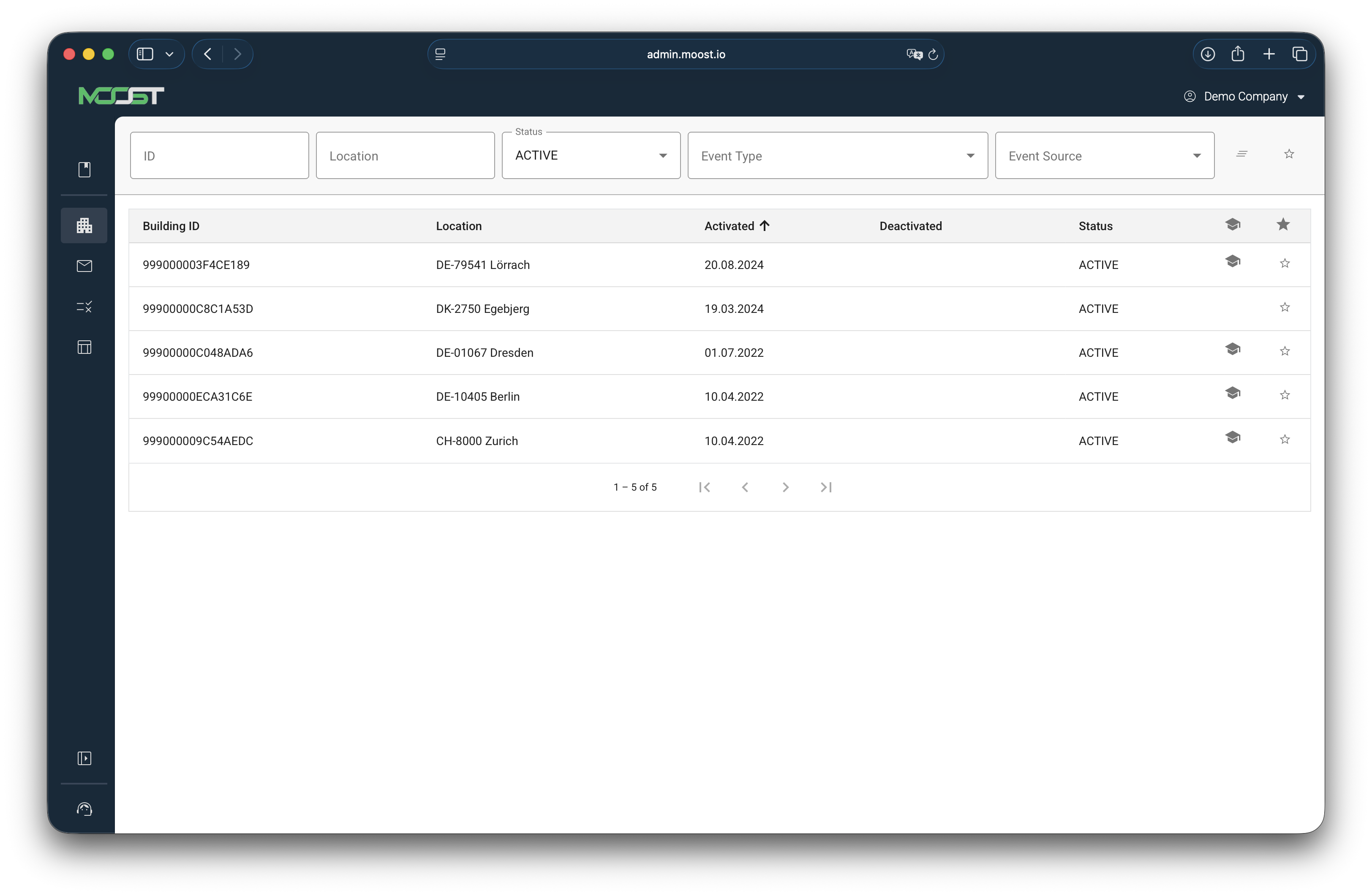
The Households section provides an overview of all households within the system. From here, you can browse, search, and manage households, as well as drill into individual household details to inspect energy data, device profiles, notifications, events, settings, and tariffs.
### Filters and Search
At the top of the page, you will find several filters and a search bar to help you find specific households quickly.
* **ID** — Search or filter households by their unique Household ID.
* **Location** — Filter households based on their location.
* **Status** — Filter households by their status (e.g., Active, Inactive).
* **Event Types** — Filter households by the types of events associated with them.
* **Event Sources** — Filter households based on the sources of their events.
### Household List
Below the filters, you will see a table of households with the following columns:
* **Household ID** - The unique identifier for each household.
* **Location** - The location of the household, including city and country code.
* **Activated** - Date and Time when the household was activated on the platform.
* **Deactivated** - Date and Time when the household was deactivated on the platform.
* **Status** - The current status of the household (e.g., Active).
* **Early Adopter** - The first icon indicates if the household is in the early adopters group.
* **Favorites** - The star icon indicates if the household is in the favorites list in the shortcut menu.
#### Actions
For each household listed, there are action buttons to perform various tasks:
* **View (Circle Icon)** — Click to open the Household Detail page.
* **Edit (Pencil Icon)** — Click to edit the household's information.
* **Early Adopter (Hat Icon)** — Indicates if the household is in the list of early adopters.
* **Star (Star Icon)** — Click to mark the household as a favourite for quick access.
#### Pagination
* **Page Navigation** — Use the arrows to navigate between pages.
---
# Agent Instructions
This documentation is published with GitBook. GitBook is the documentation platform designed so that both humans and AI agents can read, navigate, and reason over technical content effectively. Learn more at gitbook.com.
## Querying This Documentation
If you need additional information that is not directly available in this page, you can query the documentation by asking a question.
Perform an HTTP GET request on the following URL with the `ask` and `goal` query parameters:
```
GET https://doc.moost.io/platform-manual/buildings.md?ask=&goal=
```
`ask` is the immediate question: it should be specific, self-contained, and written in natural language.
`goal` is what the user is ultimately trying to achieve, the reason they need the answer. Sharing it helps GitBook give you a better, more relevant answer. A goal is most helpful when it describes the outcome the user wants rather than restating the question. For example, with `ask=how do I create an API token`, a goal like `automate deployments from our CI pipeline` lets GitBook tailor the answer to that use case.
The response will contain a direct answer to the question and relevant excerpts and sources from the documentation.
Use this mechanism when the answer is not explicitly present in the current page, you need clarification or additional context, or you want to retrieve related documentation sections.